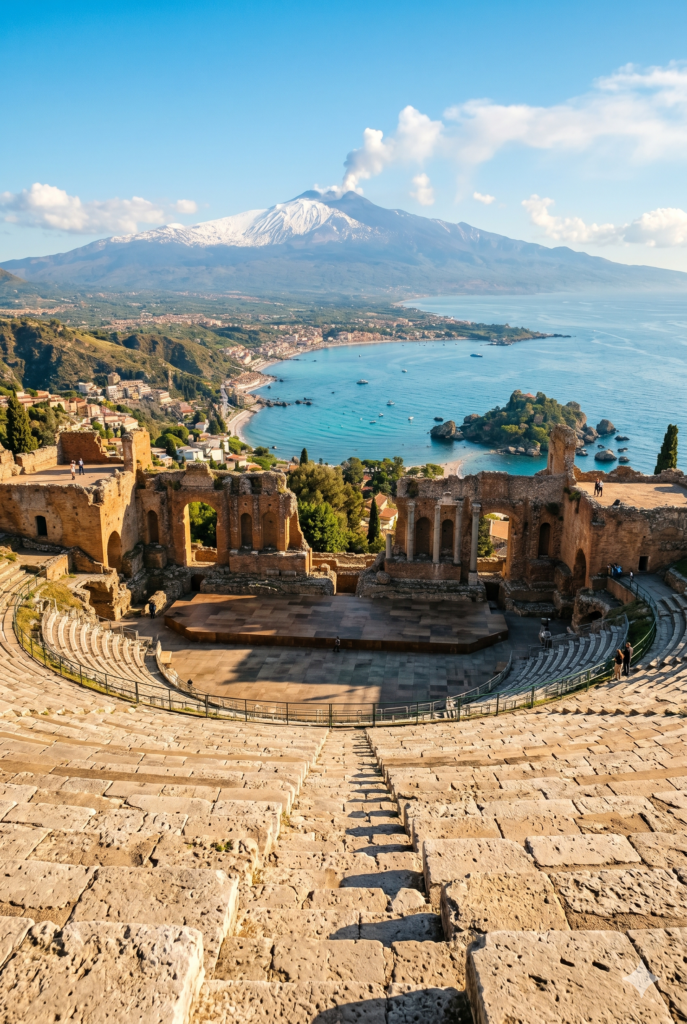
Mount Etna is the highest active volcano in Europe and one of Sicily’s most extraordinary experiences.
If you are visiting Sicily, a Mount Etna excursion is almost essential: ancient craters, volcanic landscapes and breathtaking views create an experience unlike anywhere else.
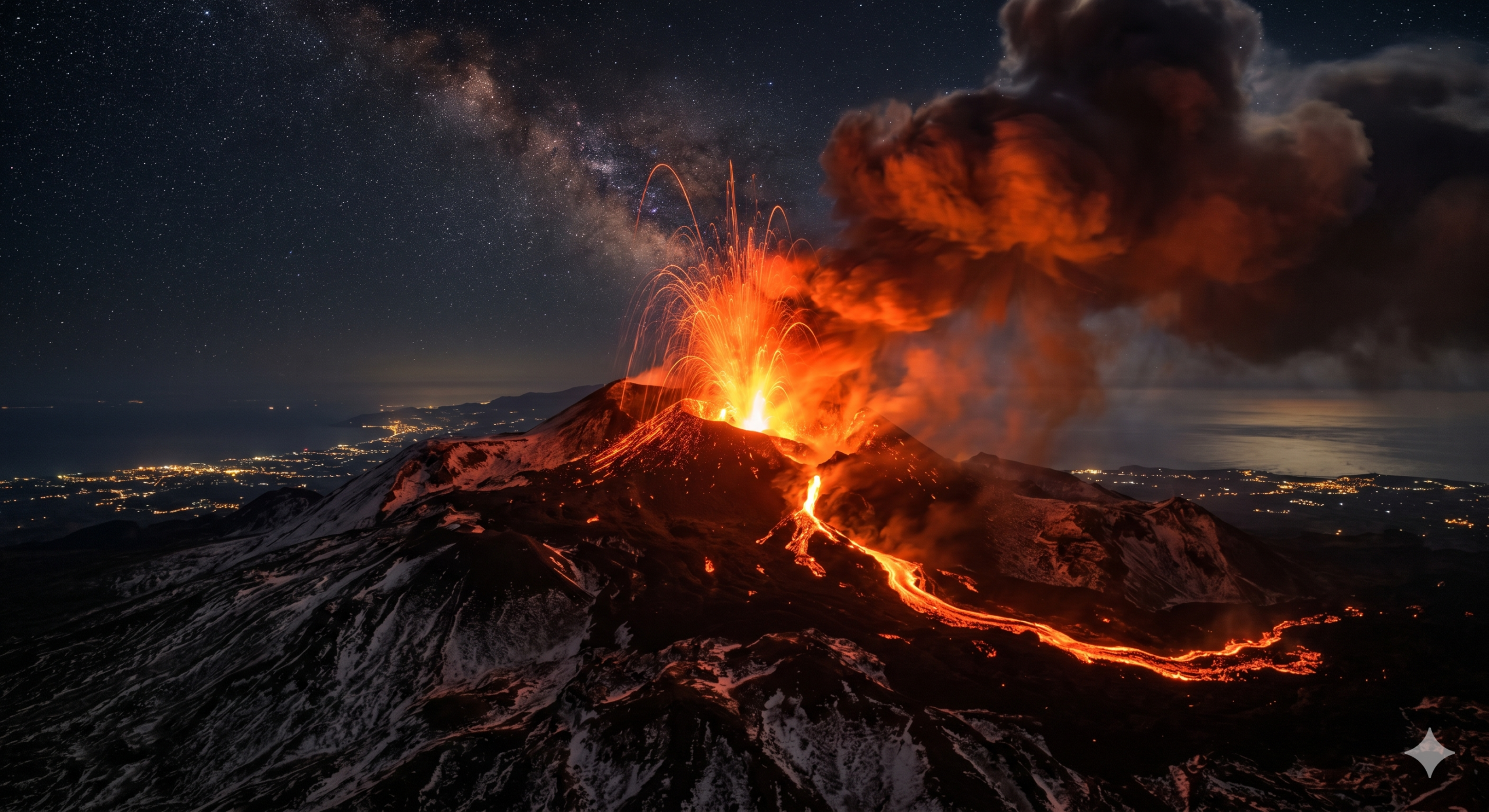
Powerful and fascinating at the same time, Etna constantly changes its appearance through eruptions, lava flows and snow-covered winter landscapes.
For people in Catania, Etna is more than a volcano.
Many locals affectionately call it “Mamma”, because it seems to watch over the city while overlooking the sea, Messina and the Aeolian Islands.
Discovering Mongibello: the Mountain of Mountains
Throughout history, Etna has had many names.
One of the most fascinating is Mongibello.
The name combines the Latin word mons (“mountain”) and the Arabic jebel (“mountain”), creating a repeated expression emphasizing its grandeur:
“The Mountain of Mountains.”
Other historical interpretations connect the name to Mulciber, one of the names associated with Vulcan, the Roman god of fire.
Even today, many Sicilians simply call Etna:
“a muntagna” — the mountain.
The myths behind Mount Etna
Mount Etna has always inspired stories and legends.
Ancient civilizations often used myths to explain the uncontrollable power of nature.
The Nymph Etna and Typhon
According to legend, the nymph Etna, daughter of Gaia and Uranus, buried her half-brother Typhon beneath the mountain.
Typhon was a terrifying creature defeated by Zeus during a legendary battle.
People believed that every volcanic eruption represented Typhon’s anger as he tried to break free.
Hephaestus and the Philosopher’s Tower
Another famous story says that the volcano contained the forge of Hephaestus, god of fire and metalworking.
One of the most fascinating legends involves Empedocles, the Greek philosopher from Agrigento.
According to tradition, he threw himself into the volcano to prove his divine nature.
The volcano rejected one of his bronze sandals, revealing that he was mortal after all.
Today the Philosopher’s Tower (Torre del Filosofo) still remembers this legend.
The history of Mount Etna eruptions
Etna’s geological history is written in lava.
Some of the most significant eruptions include:
1329 and 1381
Medieval eruptions that frightened local communities.
1669
One of the most destructive eruptions in Etna’s history. Lava reached the sea and partially devastated Catania.
1910
An eruption that created twenty-three new craters.
1917
A spectacular lava fountain rose nearly 800 meters into the sky.
1923
An extraordinary event where lava remained hot for more than eighteen months.
Nicolosi: the perfect starting point
For many visitors, Nicolosi is considered the gateway to Mount Etna.
From here most excursions begin, allowing visitors to explore lava fields, extinct craters and volcanic landscapes.
The beauty of Etna also fascinated writers and travelers.
During his journey through Italy, Johann Wolfgang von Goethe described the extraordinary landscape stretching from Messina to Syracuse beneath the smoking volcano.
Many travelers combine a Mount Etna excursion with exploring Catania.
Why a Mount Etna excursion is unforgettable
Visiting Mount Etna means more than climbing a volcano.
It means walking through mythology, history and nature at the same time.
You are following the same paths imagined by philosophers, poets and ancient gods.